Veteran to Veteran
When a Veteran leaves the 'job' and retires to a better life, many are jealous, some are pleased, and others, who may have already retired, wonder if he knows what he is leaving behind, because we already know.1. We know, for example, that after a lifetime of camaraderie that few experience, it will remain as a longing for those past times.
2. We know in the Military life there is a fellowship which lasts long after the uniforms are hung up in the back of the closet.
3. We know even if he throws them away, they will be on him with every step and breath that remains in his life. We also know how the very bearing of the man speaks of what he was and in his heart still is.
These are the burdens of the job. You will still look at people suspiciously, still see what others do not see or choose to ignore and always will look at the rest of the Military world with a respect for what they do; only grown in a lifetime of knowing.
Never think for one moment you are escaping from that life. You are only escaping the 'job' and merely being allowed to leave 'active' duty.
So what I wish for you is that whenever you ease into retirement, in your heart you never forget for one moment that you are still a member of the greatest fraternity the world has ever known.
NOW... Civilian Friends vs. Veteran Friends Comparisons:
CIVILIAN FRIENDS: Get upset if you're too busy to talk to them for a week.
VETERAN FRIENDS: Are glad to see you after years, and will happily carry on the same conversation you were having the last time you met.
----------------------------------------------------
CIVILIAN FRIENDS: Have never seen you cry.
VETERAN FRIENDS: Have cried with you.
---------------------------------------------------
CIVILIAN FRIENDS: Keep your stuff so long they forget it' s yours.
VETERAN FRIENDS: Borrow your stuff for a few days then give it back.
--------------------------------------------------
CIVILIAN FRIENDS: Know a few things about you.
VETERAN FRIENDS: Could write a book with direct quotes from you.
---------------------------------------------------
CIVILIAN FRIENDS: Will leave you behind if that's what the crowd is doing.
VETERAN FRIENDS: Will stand by you no matter what the crowd does.
---------------------------------------------------
CIVILIAN FRIENDS: Are for a while.
VETERAN FRIENDS: Are for life.
---------------------------------------------------
CIVILIAN FRIENDS: Have shared a few experiences...
VETERAN FRIENDS: Have shared a lifetime of experiences no citizen could ever dream of...
---------------------------------------------------
CIVILIAN FRIENDS: Will take your drink away when they think you've had enough.
VETERAN FRIENDS: Will look at you stumbling all over the place and say, 'You better drink the rest of that before you spill it!' Then carry you home safely and put you to bed...
-----------------------------------------------------
CIVILIAN FRIENDS: Will ignore this.
VETERAN FRIENDS: Will forward this.
---------------------------------------------------- A veteran - whether active duty, retired, served one hitch, or reserve is someone who, at one point in their life, wrote a blank check made payable to 'The Government of the United States of America ' for an amount of 'up to and including my life'.
From one Veteran to another, it's an honor to be in your company. Thank you for your service to our country and defending the freedoms we enjoy.
17 January 2011
Veteran To Veteran
I received this by email and though it does not relate directly to the Border Patrol, I thought that it may be of interest to readers of this blog .....
Semper Fi,
Agent Nowhere Man


14 June 2010
28 September 2008

20 July 2008
The Great Gunfight


One day, an Agent known as The Professor reported for work at Station One in El Paso at about 4 pm. Pneumonia Wilson was waiting for him and motioned him into one of the interview rooms. He had a problem and sought The Professor's advice.
When he got to El Paso Sector, Punchy began calling this Agent "the Professor" and he was right. He was destined to teach at the Academy at Port Isabel.
This apodo led the other PIs at El Paso to treat The Professor like a jailhouse lawyer, and they often came to him for advice when they were in trouble. I don't know exactly why they thought him a sage beyond what Punchy named him, but I assume they knew the advice was free and probably worth about what it cost.
Penumonia had a problem. He had been in a shoot-out with a Tonk; the Tonk was in the hospital and he was worried about what to write on his report. The Professor told him to tell the whole story, and he did.
He and Center-Fire Reaves had been assigned the day shift working the Sandhills. This was an area West of El Paso and was mostly just that: sand hills. In this area, just at the point where the Southern Pacific Railroad turned Southwest to make its journey to San Diego through the Gadsden Purchase, there was a railroad siding where the SP kept a few empty boxcars.
Anapra was a wide spot in the old road between El Paso and Las Cruces, NM. This siding is near that village and seems to have picked up its name by that proximity. It was then a village of a hundred or so souls, but there is a race track out there now and is probably a lot bigger than it was.
There, also, were five houses that the railroad built for the section gang for that section of the SP. The section foreman and four gandy dancers had lived there with their families, and it was their job, years before, to maintain the track. However, by that time, section gangs were a thing of the past and four of the houses were empty and abandoned.
The Professor can't remember now who inhabited the one house there but he had a rifle and the Tonk broke in and stole the rifle along with a box of ammunition. This area was west of Monument One and there was nothing but a three-strand barbwire fence along the border. Wets would walk across the border and come up and sleep in the empty boxcars or hide in the brush until the train came along and then jump in for a ride to Arizona or California.
In this case Pneumonia and Center-Fire were cutting sign along the railroad track when they saw a footprint coming from the border. They stopped; Pneumonia got out, and Center-Fire was to continue on and make a big circle.
The tracks led Pneumonia toward the one house the Tonk had broken into but the Tonk had gone out the back way and was behind another house. He saw Pneumonia and began firing at him with the stolen rifle.
Pneumonia made for the first obstacle between him and the Tonk, and that happened to be a skinny telegraph pole. Pneumonia was a big man and he tried to shrink to about half his size to fit behind the pole while the Tonk was banging away at him.
The Tonk ran on behind a boxcar and Pneumonia ran to the near side of the same car. From there Pneumonia dropped down on his knees and he could the legs of the Tonk on the other side, at least that part of his legs below the boxcar. Pneumonia took aim and shot him in the leg, just at the shin. The Tonk began hopping around and, when he stopped, Pneumonia shot him in the other leg.
While he was telling it, a light went off in The Professor's head. We all carried S&W .357 Magnum revolvers and The Professor was wondering why the Tonk still had legs when it dawned on him.
The Professor pointed his finger at Pneumonia and said, "you had wadcutters in your revolver, didn't you?"
He got a sheepish grin on his face and said yes. The Professor said, "You were going out there to shoot rabbits, wern't you?" He admitted the same. That explained it. Wadcutters were bullets for shooting paper targets on the pistol range and had about half the powder of regular ball ammo and about a third of the powder of a .357 charge.
Pneumonia continued his narrative. When the wet dropped to the ground, Pneumonia ran around the end of the boxcar and pumped a bullet into the guy's gut. Now some thirty bullets had been fired and Center-Fire had heard none of them. Nothing. He was still driving happily around out there looking for tracks, carefree as a lark.
Center-Fire had dreams of a big shoot-out where he would fast-draw and kill as many bad guys as Dirty Harry. He had many fantasies, all involving shoot-outs, and he often would share them with us. He carried a Colt .44 caliber revolver and loaded his own cartridges. He managed to increase the velocity of these hand-loads higher than the .357s by putting tin in the lead when he cast his bullets. He always loaded up with hollow points. He was in the middle of one of these fantasies when all this happened, we figure, and reality was never as interesting as his dreams.
Pneumonia disarmed the Tonk and began firing into the air. Finally, Center-Fire responded. When he got back Pneumonia had the Tonk and the Tonk was crying and carrying on something fearful. Center-Fire was shocked and disappointed. He had missed the big shoot-out!
They loaded the Tonk up and took him to Thomasen General, put a hold on him, and came to station one.
What should he do, Pneumonia asked. Go make an I-213 on him, The Professor said, while he writes out the narrative on this story. The Professor concocted a logical story by weaving a few wisps of the truth among a vast skein of bumbling ineptitude and made it sound as if the wadcutters had been ball ammo that just grazed his shins. Pneumonia's part in this incident became heroic. The Professor polished it until it fairly reeked of verisimilitude and turned it over to Pneumonia for his report. Pneumonia rounded up Center-Fire and rehearsed the whole scene for half an hour.
They all were kinda hoping that the Tonk wouldn't live over the shot in his gut and the story would just die. However, the doctors dived right in, operated right away, and saved the guy. They had a secure ward over there where they put him and he couldn't get away.
After the Tonk recovered at taxpayer expense the district office prosecuted him. He drew a sentence but The Professor can't remember how much. A formal deportation of the tonk followed. Nobody at sector across the street ever referred to this event. If the chief knew anything he must have decided to leave this one alone.
Pneumonia was neither rewarded nor punished. The Professor's part in it was never discovered. The deception was never uncovered. Center-Fire later began to tell his part in this incident. He told it just the way The Professor wrote it. The event faded away just as all the other questionable (and sometime hilarious) incidents at El Paso did. It was the best possible ending for bizarre tale that could have been disastrous.
06 June 2008

This Is A Caltrop
There are many like it, but it is my caltrop. In fact, before I was introduced to the innovative genius of caltrops, I (and a good number of Journeyman Agents) carried bricks.
The first time I witnessed a brick in use was just after I graduated from the Academy. I had been assigned to Joe as a supervising/training Agent for a two week period of 4P to 12MN shift. One evening, Joe and I were driving from Point A to Point B when a call came over the radio that someone had just "run the port" in a van with no windows.
Since we were fairly nearby, Joe instructed me to pull off into the desert and away from the road. He wanted to wait for the van and I could tell that he was really hungry to catch it and see what was inside. My mind raced. Dope? People? Both? I was stoked and so was Joe.
Sure enough, the van topped a rise in our direction and I started the Ramcharger. As soon as the van was close, I inched-out toward the hard surface road. Just after the van passed, I stomped it and we were off. I lighted-up the reds. He didn't stop. I flashed the headlingts and sounded the horn (our desert vehicles didn't have sirens). He still didn't stop.
Joe instructed me to pull along side of the van. I did what I was told. When we were even with him, Joe leaned out the passenger window and yelled at the guy to pull over. The driver flipped Joe off and simply kept looking straight ahead.
It was then that Joe instructed me to pull forward enough so that Joe would be even with the van's front bumper. In the time it had taken me to do that, Joe had reached into his trique bag on the floor and extracted a brick. He threw it out his window. The brick impacted the van's windshield at about eighty miles an hour and the whole affair spiderwebbed. The van finally stopped and we were able to find the drugs that the driver desperately tried to keep us from finding.
A few months later, some of us were talking with another Agent from a Sector farther to our West. This guy had been a New York City police officer before he had gone to the Border Patrol Academy. He told us about caltrops and how he believed them to be much more effective than bricks. After giving it some thought, we had to agree with him.
Naturally no Chief Patrol Agent will ever want to know that his Agents carry them. He will probably also never admit that he carried them when he worked the Line.
18 January 2007
The Miracle of Styrofoam in the Days Before RICO
 Jack, Angel, Jim, and I were assigned to work the desert area 6P to 2A (actually 4A with "Uncontrollable Overtime"). This area of The Line runs East from San Luis, Arizona way, way past International Boundry Marker 198. Part of the area contains the bombing range for Marine Corps Air Station, Yuma. It's a vast area of emptiness that includes much of interest if one knows where to look.
The Other side of The Line was occasionally patrolled by the the Frontier Battalion of the Mexican Army. But not much. Some of The Line in those parts was marked by a 3-strand barbed wire fence. East of 198, there was no fence at all.
It must have been about 2330 that we received a call from Jack that he was cutting for sign around the agricultural inspection station. Jack saw headlights on the drag road about two miles to his East and wanted to know if it was any of us. It wasn't. The rest of us were either much farther West or East of where Jack was. Each of us told him so.
Sometimes, USDA folks would be on the drag raod ... but not at that time of night. Jack headed for the headlights. The rest of us bumped across the desert toward Jack's sighting of the lights.
In a couple of minutes, Jack had cut tire sign where a vehicle had plowed through the fence and headed cross-country across the desert toward the edge of the mesa some 8 or 9 miles to the North. Jack told the rest of us what the sign looked like.
Angel and Jim spotted Jack first (they were the closest to him when the call came) so they began traveling parallel to his direction of travel. Angel a half mile to Jack's left and Jim, a half mile to Jack's right.
Since I was coming from the North, my job was to cut perpendicular to the route of travel of the Agents and the smugglers. When I started my cut and flashed my spotlight in Jack's direction, the smuggler and the chase party all did a very rapid 180 and began heading South. It was a literal race for the border. The smuggler was attempting to make it back to Mexico.
Remember, we're talking about great distances. Jack, Angel and Jim were about a mile and a half behind the load car when it turned. There was no way we could catch him before he made it back to Mexico .... but we subjected our Ramchargers to metal fatigue caused by high-speed desert bumping anyway. We had to try.
By the time I arrived at The Line Jack, Jim and Angel were already there, but the smugglers weren't. They had gotten the load car 3/4 into Mexico before it had bogged down in the soft sand at the fence. They had popped the trunk and were throwing kilos of marijuana over the fence into Mexico when Jack, Angel and Jim had arrived. At that point, the smugglers ran off into the dark of Mexico - abandoning the weed as well as the car.
We switched off our lights and, gingerly, went 10 feet into Mexico and started throwing the kilos back onto our side of The Line (to be logged and destroyed later in our shift). But the car was another matter. We knew that, as soon as we left the area, the drugistas would come back and dig out the car and take it all the way into Mexico so they could use it again.
None of us wanted that to happen, and were discussing the lousy turn of events when Jim just grinned at us.
Jim went back to his vehicle and got a styrofoam coffee cup, tore it into tiny pieces and dumped them all down the gas tank of the load car. The effect, he told us, would be that they would dissolve in the gasoline and totally lock-up the engine a few minutes after the next time it was turned on. It must have been true because we never saw that car hauling drugs again.
V/F
Agent Nowhere Man
09 January 2007
Compean and Ramos
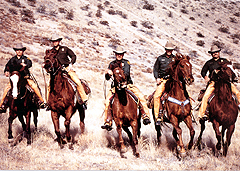
I'm surprised that our El Presidente has not pardoned them yet. At the very least, he should have directed his Justice Department to give them parole status while their cases wind their way through the appeals courts.
No one has publically stated this (to my knowledge), but the Commander-In-Chief's inaction is curious indeed. Why? On one hand he is fighting a War on Terrorism while, on the other hand he is presiding over Northern and Southern borders that are worse than leaking ... they're gushing Tonks of all varities into our country.
Why? I'm afraid that I don't know. What I do know, however, is that any one of the Cartels has vast financial resources. Most people aren't aware of just how breathtaking is their capability to purchase all sorts of things and conditions of political security. Taken together, the amount of liquid capital available to the combined Cartels is truly staggering. Who, in their right mind can deny that substantial amounts of Cartel profits find their way into various pockets in our own country.
Please, do not misunderstand what I write. I'm not infering that our President is in receipt of illegal drug profits and is allowing the borders to be open as a quid pro quo for the favors received. I am simply stating that it's difficult to imagine that all those drug profits remain South of the border. Especially as our persecution of Agents for doing their jobs seems to be escalating. Someone or a group of Someones who influence and enforce the administrative law that controls U. S. Border Patrol Agents may be the largest fish in this pond ... while our poor, El Presidente takes it in the political shorts.
There was another (not myself) before Compean and Ramos who fell out of favor for doing his job. The difference he enjoyed is that he was just quietly retired.
As far as finding the folks who are really responsible for what's happening to Compean and Ramos, the answer is simple: follow the money. The hard part is that no one wants to.
V/F
Agent Nowhere Man
28 January 2006
Mexican Military
I can recall an operation in which the Mexican military was the distinct bad guy.
It seems that numerous loads of weed amd coke were coming North. The goods were paid for, not in money but in other goods. The payment was made in military weapons.
Here's the short version of the story: The particular Cartel producing and transporting the drugs was an OTM (Other Than Mexican) Cartel. They paid the Mexican military to guard their shipments as they passed through their country into ours. The drop-off point for the drugs was in a tiny town in extreme Northern Baja California in a little house that had been abandoned some years earlier. The drugs would come North out of the little town and the payment would be placed under the floorboards of the house.
We worked the case in conjunction with the Federali and the Judicial (State Judicial Police) of Baja California. After we had seized the drugs on our side, the Mexicans (accompanied by ourselves) raided the little house and discovered the weapons where they had been hidden. The weapons discovered were M-60's and M-16's. We, later, discovered that they had been stolen from a National Guard armory deep in the interior of our country.
This operation was meant to be a sting but, in the end, no one was stung except the Cartel. The Mexican Army had already received their pay-offs and were out of the picture. The Federali and the Judicial had absolutely no was to prove that anyone in the Mexican Army had taken payment for their part in the affair.
Needless to say, that was the last time that little town and that little house was used in that Caretl's part of the drug trade. The bonus for us was that three law enforcement agencies began to solidify ties with each other that are stronger today than ever before.
The Mexican Army? Well, those cats are still guarding the drug shipments ... only now they're daring to traverse the Line in order to do it.
V/F
Agent Nowhere Man
25 October 2005
If I'm Nowhere, Why Do This At All?

I am, in fact, Nowhere. Actually, I'm somewhere but there are people who are casually looking for me who I do not wish to be successful. We have created problems for each other in the past; theirs was imprisonment while mine were of a more personal nature.
The agency from which I retired is the U. S. Border Patrol. Numerous instances exist wherein the USBP is exactly the same as it has always been and there are others in which it is radically different. The similarities have to do with managerial mind-set and the differences pertain to tactical application of the managerial mind set.
In later posts, I'll attempt to describe (through my own memories as well as those of others) what it was like in what is called the "Old Patrol".
As to any bona fides I may have, my training in tracking was given by a student of Ab Taylor. Weapons instruction was accomplished by three men; the most notable of which was Bill Jordan. The other two are still living and, for their safety, I choose not to reveal their names.
Stay tuned and we can ride the line together.
Deo Vindice
Agent Nowhere Man
Subscribe to:
Posts (Atom)