30 April 2011

Drag Roads

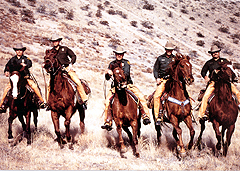
What you see above is a Drag Road. In Terms of Border Patrol operations, Drag Roads usually run parallel to the international boundary line - The Line. They can, sometimes, be utilized some miles in the interior perpendicular to known routes of Tonk travel.

Metal drags are made entirely of metal in the shape of a "C". This type of drag is excellent for smoothing-out "washboarding" of dirt roads (caused by yahoos driving too fast on them). The best type of drag is constructed of used tires bolted together and attached to a metal bar; the more tires the better. A six or an eight tire drag is superb for producing a glass-like appearance on the road. When towed at a speed of about 5 mph, the tire drag produces an appearance on the road that has no equal when it comes to the initial sign cutting.

The Border Patrol still uses drags to perform the necessary function of clearing old and already-chased sign from The Line and from other roads in the interior. The dirt around head gates on canals are simply raked-out with a common metal rake to create a clean slate for new foot traffic.

Once the road has been dragged the sign cutting (looking for sign) actually begins. As much as possible, it is desirable to cut into the sun. This way, the shadows created by the sun on the side of the sign facing the sign cutter make the sign stand out like a billboard.

Some Tonks attempt to obliterate their sign across a drag road by dragging a branch filled with leaves behind them. The brush-out shows up as well as the actual footprints. All the tracker has to do is to follow the brush-out until the Tonk has dropped the branch. Then, his or her sign will be recordable. For example: "I'm following a group of six that brushed-out two miles East of the Port of Entry (POE). They're 3 diamond tennies, one plain flat and a broken-line irrigator boot".
Armed with such information, Agents farther in the interior can begin looking for the same sign upon known avenues of travel.

There is much experience required to be a tracker and no one person is perfect at the endeavor. Some, though, can come fairly close to perfection. The Agent who taught me, Eli, was known for his ability to cut sign across malapai. One of the Old Patrol has written a book on the subject. His name is Joel Hardin and his book, Tracker, can be found on Amazon (the last time I checked).


This Border Town

There were songs of the Old Patrol that were written and sung by Agents such as Tommy Shelton. I can't find them anywhere and lack the expertise of posting the audio I have on cassette tape of Tommy singing them. Like Western Music, they told stories. Most of Tommy's were concerned with the innate integrity of human beings and the infrequent displays of honor among contrabandistas. This one is more current; I'm fairly certain that it wasn't written by and Agent (current or retired). Still, it is supported by good photography and an honest description of what the average Tonk believes about Los Estados Unidos.

The problem with it is that doesn't acknowledge that we know that the only place where the streets are paved with gold is Heaven.

29 April 2011

U.S. Border Patrol is Using Video Games Technology to Help Keep Border Safe - FoxNews.com

U.S. Border Patrol is Using Video Games Technology to Help Keep Border Safe - FoxNews.com


In January, citing missed deadlines and cost overruns, the Obamaadministration scrapped the virtual border fence project, which was a system of sensors,radar, video and other technology as a way of spotting illegal immigrants crossing over.


Now, with funding from the DHS, Customs and BorderProtection (CBP) is exploring ways, through video game simulation, to make sure the same mistakes aren't made again -- and work out questions like how much fence and what kind of fence is needed or how sensors, vehicles and other technical equipment can best be used.


The virtual games allow users to track people moving across the border, see how agents respond and control outcomes to apprehend suspects.


Users can also see how many suspects have been apprehended, what resources went into them, as well as the dollar amount spent.

Ask any Patrol Agent who knows how to cut sign and chase: the fence was a bad solution to a real problem. If present-day Agents were all proficient in sign cutting and chasing and were allowed to do it, the need for a fence would be non-existent.


Border Patrol Agents using virtual reality to solve the problem is, also, a laughable matter. The problem is real and it is one whose only solution is teaching Agents how to apply their statutory authority and, then, allowing them to use it.

DHS and CBP appear to be administered by fools.


27 April 2011

Trump appears in N.H., but doubts about possible bid remain - Politics Wires - MiamiHerald.com

Trump appears in N.H., but doubts about possible bid remain - Politics Wires - MiamiHerald.com:
"Donald Trump may have looked and sounded like a presidential candidate as he paraded around New Hampshire on Wednesday, the site of the first 2012 primary, but GOP insiders remain dubious that he's going to mount a serious campaign."

Trading one demagogue for another does not seem as if it would be a good idea for the future of what's left of the Republic. Trump is, as is Obama, a bully. They share the bully's ultimate flaw: cowardice. In each of them, the cowardice is manifested differently. In Trump it can be seen in his lack of strength for interpersonal commitment across gender lines. In Barry, the cowardice is displayed in his remarkably deft ability to play the game called "Let's-You-and-Him-Fight". He plays the game by surrounding himself with his sorry allotment of Czars who are little more than shills and Fellow Travelers of the most foul stripe.

30-Yr Treasurys Fall As Inflation Concerns Follow Bernanke, Fed - WSJ.com

30-Yr Treasurys Fall As Inflation Concerns Follow Bernanke, Fed - WSJ.com:
"In his first-ever, post-policy meeting briefing, Chairman Ben Bernanke largely repeated the earlier Fed policy statement, saying the economic recovery still needs some stimulus."

There is something fundamentally skewed with Bernanke's comprehension as to the "hows" of economic recovery. The only "stimulus" possible, in his thinking, is to spit (spend) more make believe dollars into the whirlwind.

Texas (after the initial shock and necessary adjustments) would probably be better off separating itself from the crazies and going it alone (or with other like-minded States). Barring that, the last thing the United States needs to be doing is going deeper into debt in a feeble attempt to recover from debt. If I were to do run my personal finances in such a manner, I'd have been bankrupt long ago.

Deo Vindice

24 April 2011

Georgia County Votes to Keep Confederate Battle Flag Flying - FoxNews.com

It's a truly sad situation that this controversy would even happen; let alone make the news. Thank you, Board of Commissioners for standing up for heritage!

Deo Vindice


Georgia County Votes to Keep Confederate Battle Flag Flying - FoxNews.com

23 April 2011

New billboard campaign urges secession | The Gonzales Cannon

The possibility of secession frightens many and seems ridiculous to most. The ones who are frightened are so disposed because they cannot imagine a different definition of why they are. The constituency that heaps ridicule upon the idea of secession because they view it as being antiquated, backward and associated with human slavery.

New billboard campaign urges secession | The Gonzales Cannon

For us - today - secession is all about being who we have always been. It is an affirmation of who we are and always have been. Before we were Americans, we were - and still are - Texans.

Gas Prices Pinch, And Obama Feels The Pain : NPR

Black Barry's continuing denial of the obvious would be amusing if it were not affecting the economy.

"The truth is, the only real solution to helping families at the pump in the medium- and long-term is clean energy," he said. "That's how we'll save families money. That's how we'll reduce our dependence on foreign oil. We've got to develop new technologies to lessen our reliance on fuel that is finite and that we've got to import from other countries."
He doesn't seem to grasp the fact that we have plenty of petroleum available to us. All of it lies within our own territory. Until now, I thought that Jimmy "The Failure" Carter was the worst possible Chief Executive we've ever had.

Silly me.

Gas Prices Pinch, And Obama Feels The Pain : NPR

22 April 2011

The "Old Patrol"

The "Old Patrol" is a term used by the newer level managers who were, themselves, never part of it. They are too young to have been in it. Sometimes the term is used derisively in the same manner that one of "Dirty" Harry Callahan's Lieutenants described him as being a Neanderthal.

The Old Patrol was the outfit respected by just about all law enforcement agencies in the country. The Old Patrol members were not hampered by the stifling dictates of political correctness. They had a job to do; they knew how to do it and they were well-versed in their necessary statutory authority. The job wasn't over until the chase was completed and the Tonks and smugglers had all been processed.

Members of the New Patrol must harbor secret fantasies about what they have read about the Old Days. Most, I imagine, have read No Second Place Winner long before they took the written exam prior to the Academy. Once they actually start the job, they quickly discover that the world inhabited by Bill Jordan, Charlie Askins and Skeeter Skelton no longer exists for them.

There is probably a good reason that it does not: there are considerably more of them these days than there were of us. (There are - or recently have been - actual Border Patrol Recruiters ... something unheard-of in the Old Patrol) These days, Agents are drawn from a considerably larger "pool" and many of them bring with them the mental and emotional bacteria which still clings to them from those waters. When I Entered On Duty (EOD'd) after the war in Viet Nam, there were less than three thousand Border Patrol Agents nation-wide. Now, there are many times that number.

Once we graduated from the Academy, we were all able to take sworn statements from aliens and from smugglers in both Spanish and in English and to translate from one to the other. We prepared cases for prosecution. Not so anymore.

Post Academy probationers learned how to read sign and to track from Journeyman Agents. Trainees were expected to display initiative by cutting sign and to initiate a chase without being granted permission from anyone else. Not so anymore.

The Old Patrol had no such thing as BORTAC. The concept of an "elite-within-an-elite" would have been laughable to us. Once an individual made it off of probation, he was expected to do what was necessary to accomplish securing his portion of The Line ... or of The Railroad Yards ... or of Farm and Ranch work ... or of Traffic/Transportation work ... or of Marine Operations.

For those of us who lived it, the Old Patrol was simply something we assimilated into. The odd thing was that, at the time, none of us realized that one day we would be regarded as Neanderthals.

Homeland Security secretary travels to Artesia, NM, for Border Patrol ceremony :: The Republic

Janet The Clueless continues to make her presence felt among those who have every right to resent it.

Homeland Security secretary travels to Artesia, NM, for Border Patrol ceremony :: The Republic


17 January 2011

Veteran To Veteran

I received this by email and though it does not relate directly to the Border Patrol, I thought that it may be of interest to readers of this blog .....

Semper Fi,

Agent Nowhere Man

Veteran to Veteran

When a Veteran leaves the 'job' and retires to a better life, many are jealous, some are pleased, and others, who may have already retired, wonder if he knows what he is leaving behind, because we already know.

1. We know, for example, that after a lifetime of camaraderie that few experience, it will remain as a longing for those past times.

2. We know in the Military life there is a fellowship which lasts long after the uniforms are hung up in the back of the closet.

3. We know even if he throws them away, they will be on him with every step and breath that remains in his life. We also know how the very bearing of the man speaks of what he was and in his heart still is.

These are the burdens of the job. You will still look at people suspiciously, still see what others do not see or choose to ignore and always will look at the rest of the Military world with a respect for what they do; only grown in a lifetime of knowing.

Never think for one moment you are escaping from that life. You are only escaping the 'job' and merely being allowed to leave 'active' duty.

So what I wish for you is that whenever you ease into retirement, in your heart you never forget for one moment that you are still a member of the greatest fraternity the world has ever known.


NOW... Civilian Friends vs. Veteran Friends Comparisons:

CIVILIAN FRIENDS: Get upset if you're too busy to talk to them for a week.
VETERAN FRIENDS: Are glad to see you after years, and will happily carry on the same conversation you were having the last time you met.
----------------------------------------------------
CIVILIAN FRIENDS: Have never seen you cry.
VETERAN FRIENDS: Have cried with you.
---------------------------------------------------
CIVILIAN FRIENDS: Keep your stuff so long they forget it' s yours.
VETERAN FRIENDS: Borrow your stuff for a few days then give it back.
--------------------------------------------------
CIVILIAN FRIENDS: Know a few things about you.
VETERAN FRIENDS: Could write a book with direct quotes from you.
---------------------------------------------------
CIVILIAN FRIENDS: Will leave you behind if that's what the crowd is doing.
VETERAN FRIENDS: Will stand by you no matter what the crowd does.
---------------------------------------------------
CIVILIAN FRIENDS: Are for a while.
VETERAN FRIENDS: Are for life.
---------------------------------------------------
CIVILIAN FRIENDS: Have shared a few experiences...
VETERAN FRIENDS: Have shared a lifetime of experiences no citizen could ever dream of...
---------------------------------------------------
CIVILIAN FRIENDS: Will take your drink away when they think you've had enough.
VETERAN FRIENDS: Will look at you stumbling all over the place and say, 'You better drink the rest of that before you spill it!' Then carry you home safely and put you to bed...
-----------------------------------------------------
CIVILIAN FRIENDS: Will ignore this.
VETERAN FRIENDS: Will forward this.
----------------------------------------------------

A veteran - whether active duty, retired, served one hitch, or reserve is someone who, at one point in their life, wrote a blank check made payable to 'The Government of the United States of America ' for an amount of 'up to and including my life'.

From one Veteran to another, it's an honor to be in your company. Thank you for your service to our country and defending the freedoms we enjoy.

14 June 2010

28 September 2008

Air Operations - Back In The Day

Photobucket

In our air operations group we have had some pretty exotic people who were pilots. I am using the past tense because some of them have transferred to other locations or retired, and the group is not the same as it was before I retired. In fact, the Border Patrol, now, has no pilots. All pilots are CPB.

To be a Border Patrol pilot it is required that you have a commercial pilots license, instrument rating, fifteen hundred hours experience (a large portion must have been as commander of the aircraft, not as a co-pilot), and you had to be "current" in these skills. If you had these qualifications, as a "fixed wing" pilot then the Service would cross train you as a "rotary wing" or helicopter pilot. If you were a "rotary wing" pilot then you would be cross-trained as a "fixed wing pilot". Since there was only an occasional opening for a pilot "trainee", you might have to wait for several years for your chance. Under these requirements nearly all of our helicopter pilots were members of the military reserve. They had learned their skills in the military and upon discharge had enlisted in the ready reserve to maintain the currency of their licenses. In 1975 it cost $300.00 an hour to rent a Hughes 500C helicopter, so maintaining currency without the military picking up the tab would have been formidable.

Consequently, after a number of years, we had three high-ranking U.S. Navy officers flying our helicopters. Two were Captains, one promotion away from being an Admiral, and the other was a "full" Commander, two steps below an Admiral. This can be pretty frightening when you know some of the fellows, kind of like "Dr. Strangelove". The two Captains were commanders of antisubmarine helicopter squadrons and the Commander was a squadron Executive Officer. All of them were Viet Nam combat veterans and thought that their Border Patrol work was "great"; no one was shooting at them. Well, they didn't get shot at too often!

The Commander, the hero of this episode, had been in a psychological warfare squadron in Viet Nam. Their helicopters had powerful outside speakers on them and they would precede or accompany units that were attacking Viet Cong positions, very loudly playing martial music and propaganda messages. After the enemy got used to this, they could disrupt the enemy's rest by simply flying around in the area and making noise, as they were perceived as a precursor of an attack. Anyway, the boys were diabolical when it came to playing mind games with the aliens.

During the winter there was extremely heavy rainfall, causing extensive flooding. Just to the west of the San Ysidro Port of Entry, the Tijuana River flood control channel enters the United States and goes west to the ocean at distances up to a mile north of the border. The flood was one of those hundred year floods that come along every five or six years. It totally overwhelmed the flood control channel. When the channel turned, the floodwaters didn't and they cut a new river channel to the ocean. This took out all of the roads and bridges to the south side of the channel.

The people that lived on the south side of the flood control channel became defacto Mexicans. There was no way to get into the United States without going into Mexico and entering through the port of entry. Consequently, the chain link fence that was the United States / Mexico border was almost destroyed. It became a series of holes tenuously wired together in spots. There were numerous dirt roads cut to ease traffic between the two sides by the United States residents trapped on the south side of the channel. The whole thing assumed a surreal quality as if "KINGS' X" had been declared.

There was a Border Patrol Agent that lived on a ranch on the south side, so he was more or less assigned to help the S.D.P.D. maintain order. He patrolled the area on one of his horses, to help prevent looting and burglaries and to generally show the flag. This went on for several weeks. The S.D.P.D. had a couple of four-wheel drive vehicles that the Navy carried over the river on an amphibious vehicle and patrol units were changed by helicopter. There was no attempt to control illegal entries south of the Tijuana River, as the river was almost forty feet deep in the concrete flood channel. While driving his Dodge "Ram Charger" on top the north wall of the levee, an Agent could pace debris floating at twenty-eight miles an hour. There wasn't anyone going to be swimming across there!

The Mexicans knew that they weren't going anywhere, so they turned the area into a giant arena to loiter and yell remarks at the "Migra" (Immigration Officials) on the other side. We had always maintained a presence on the south levee to prevent them from staging there and running "Banzai" charges to the north levee. From the north levee there was only a few hundred yards of open ground until the group would be in a densely populated residential area, MOSTLY filled with immigrated Mexicans who sympathized with them. If a group of fifty or one hundred made it into the houses, we'd be lucky to dig out five or ten.

This was their chance to "rub our noses in it" by flaunting their presence and calling us names. As was mentioned earlier, there isn't a hell of a lot of difference between the Border Patrol and the Mexicans, and two street gangs having a turf war. The feelings can run high.

The stage is now set. The Mexicans had escalated the challenge to the point of setting up tent restaurants and bars, and having street vendors selling tacos and tamales from push­carts. Lovers were strolling arm in arm while jeering at the "Migra". The B.P.A.s on the north levee were not "happy campers"!

Late one Sunday afternoon there was a "whomp-whomp-whomp" in the distance. Then it got louder. Up the flood control channel from the ocean came a Navy "Sea King" antisubmarine helicopter. Now, we are talking about a BIG helicopter. Each blade of the main rotor on the Sea King is about forty feet long and when the pilot is "pulling pitch" (has the blades angled to provide lift) the propeller wash is terrific. If you are not alert it will knock you off your feet.

The Sea King came to a hover over the water, facing the south levee, and then it began to move over the levee. The first things to go were the tent restaurants and bars, the tents went flying and all of the food and merchandise were scattered. Then it chased down the pushcart vendors. The prop wash blew the pushcarts into the water and they were last seen floating "out to sea". Then it came back and went to work on the campfires, and scattered them and anything else that could be found. Then the Sea King circled over the B.P.A.s on the north levee, gave them the helicopter equivalent of the wing wagging salute and went "whomp-whomp-whomp" back out to sea. The B.P.A.s all said to each other, "Who was that masked man?"

This pilot ended up leaving the Patrol and working for another agency in another state. We heard that he was involved in several drug apprehensions in which there were shootouts between his aircraft and the boats running drugs, but the only incident that we had confirmation of is more of a domestic one. He was patrolling one of his areas beaches when he caught a glimpse of something behind a small building on the beach. Swinging around he lit up the area and there was a citizen happily "buggering" his dog. It being a slow night, he called the police and the bad guy was apprehended. It wasn't real slow around Southern California, but everyone managed to find time to give him a call and congratulate him on his "big bust".

One of pilots was what you would call an aggressive pilot. The normal way to land a helicopter is to make an airplane type approach on the runway and then "air taxi" to the tie down area. This would stay out until the last minute, swing around over the tie down area at one hundred mph or so, do a beautiful side slip at sixty mph that would put him directly over where he wanted to land, and drop it like a feather exactly where he wanted to be. All the BP pilots who watched him do this were totally awe struck. The man is a fantastic pilot.

Nearly all of our pilots are what could be called free spirits. Any attempt to force them into conformity is sure to be met with resistance of the most insidious sort. Rick had a "full dress flight helmet" that he wore for special occasions, like when he wanted to drive someone at "Sector Headquarters" right up the wall.

He had taken a regular white military type helicopter helmet and tricked it out like a "pickelhaube", the classic Prussian spiked helmet. The left side sported a "Maltese Cross" about four inches across, and the right side had a "Blue Max" of about the same size. The "Blue Max" (known in France as the "Pour Le Merite") was a World War I medal named for Max Immeling. To earn it you had to shoot down twenty allied warplanes. It was the highest award for German flyers in World War I. Centered on the top, of course, was the traditional Prussian spike. The helmet had a very dark sun visor, like military fighter pilots wear, that covered the entire upper portion of your face.

This was worn with a military flight suit and he flew the helicopter with the doors removed so he was more visible and could be more expressive.

He would come swooping over a hill top, and pounce upon some poor group, scaring the crap out of everyone by buzzing them a few feet above their heads. He would do a tight circle or two around them while shaking his fist at them from out of the open door and shrieking maniacally over the outside loud speaker. Usually the group didn't move until the Border Patrol Agent on the ground arrived to rescue them.

All of the pilots were masters at using prop wash to stop a running group by blowing all kinds of debris at them as they are trying to run, but Rick far exceeded the criteria to be called master. Often in the Tijuana River bottom there would be huge piles of tumbleweeds that had been blown hither and yon by the wind. This game could be played in two ways. If the alien or aliens were attempting to hide in a large pile of tumbleweeds then Rick would peel the weeds away with the prop wash as cleanly as if he were cutting them out with a scalpel. Should the alien be trying to hide in a small pile of weeds, then Rick felt that he needed to be better hidden from our ground agent and again using the prop wash would bury him under huge piles of tumbleweeds (Russian Flax). After the ground agent arrived, if the alien wouldn't come out after Dave called him on the loudspeaker, the weeds were again rolled away so the agent didn't have to dig him out.

I've never tried it, but tumbleweeds are extremely prickly and I don't think that being holed up in them would be much fun; especially after running a distance and being all hot and sweaty.

20 July 2008

The Great Gunfight


One day, an Agent known as The Professor reported for work at Station One in El Paso at about 4 pm. Pneumonia Wilson was waiting for him and motioned him into one of the interview rooms. He had a problem and sought The Professor's advice.

When he got to El Paso Sector, Punchy began calling this Agent "the Professor" and he was right. He was destined to teach at the Academy at Port Isabel.

This apodo led the other PIs at El Paso to treat The Professor like a jailhouse lawyer, and they often came to him for advice when they were in trouble. I don't know exactly why they thought him a sage beyond what Punchy named him, but I assume they knew the advice was free and probably worth about what it cost.

Penumonia had a problem. He had been in a shoot-out with a Tonk; the Tonk was in the hospital and he was worried about what to write on his report. The Professor told him to tell the whole story, and he did.

He and Center-Fire Reaves had been assigned the day shift working the Sandhills. This was an area West of El Paso and was mostly just that: sand hills. In this area, just at the point where the Southern Pacific Railroad turned Southwest to make its journey to San Diego through the Gadsden Purchase, there was a railroad siding where the SP kept a few empty boxcars.

Anapra was a wide spot in the old road between El Paso and Las Cruces, NM. This siding is near that village and seems to have picked up its name by that proximity. It was then a village of a hundred or so souls, but there is a race track out there now and is probably a lot bigger than it was.

There, also, were five houses that the railroad built for the section gang for that section of the SP. The section foreman and four gandy dancers had lived there with their families, and it was their job, years before, to maintain the track. However, by that time, section gangs were a thing of the past and four of the houses were empty and abandoned.

The Professor can't remember now who inhabited the one house there but he had a rifle and the Tonk broke in and stole the rifle along with a box of ammunition. This area was west of Monument One and there was nothing but a three-strand barbwire fence along the border. Wets would walk across the border and come up and sleep in the empty boxcars or hide in the brush until the train came along and then jump in for a ride to Arizona or California.

In this case Pneumonia and Center-Fire were cutting sign along the railroad track when they saw a footprint coming from the border. They stopped; Pneumonia got out, and Center-Fire was to continue on and make a big circle.

The tracks led Pneumonia toward the one house the Tonk had broken into but the Tonk had gone out the back way and was behind another house. He saw Pneumonia and began firing at him with the stolen rifle.
Pneumonia made for the first obstacle between him and the Tonk, and that happened to be a skinny telegraph pole. Pneumonia was a big man and he tried to shrink to about half his size to fit behind the pole while the Tonk was banging away at him.

The Tonk ran on behind a boxcar and Pneumonia ran to the near side of the same car. From there Pneumonia dropped down on his knees and he could the legs of the Tonk on the other side, at least that part of his legs below the boxcar. Pneumonia took aim and shot him in the leg, just at the shin. The Tonk began hopping around and, when he stopped, Pneumonia shot him in the other leg.

While he was telling it, a light went off in The Professor's head. We all carried S&W .357 Magnum revolvers and The Professor was wondering why the Tonk still had legs when it dawned on him.

The Professor pointed his finger at Pneumonia and said, "you had wadcutters in your revolver, didn't you?"
He got a sheepish grin on his face and said yes. The Professor said, "You were going out there to shoot rabbits, wern't you?" He admitted the same. That explained it. Wadcutters were bullets for shooting paper targets on the pistol range and had about half the powder of regular ball ammo and about a third of the powder of a .357 charge.

Pneumonia continued his narrative. When the wet dropped to the ground, Pneumonia ran around the end of the boxcar and pumped a bullet into the guy's gut. Now some thirty bullets had been fired and Center-Fire had heard none of them. Nothing. He was still driving happily around out there looking for tracks, carefree as a lark.

Center-Fire had dreams of a big shoot-out where he would fast-draw and kill as many bad guys as Dirty Harry. He had many fantasies, all involving shoot-outs, and he often would share them with us. He carried a Colt .44 caliber revolver and loaded his own cartridges. He managed to increase the velocity of these hand-loads higher than the .357s by putting tin in the lead when he cast his bullets. He always loaded up with hollow points. He was in the middle of one of these fantasies when all this happened, we figure, and reality was never as interesting as his dreams.

Pneumonia disarmed the Tonk and began firing into the air. Finally, Center-Fire responded. When he got back Pneumonia had the Tonk and the Tonk was crying and carrying on something fearful. Center-Fire was shocked and disappointed. He had missed the big shoot-out!

They loaded the Tonk up and took him to Thomasen General, put a hold on him, and came to station one.

What should he do, Pneumonia asked. Go make an I-213 on him, The Professor said, while he writes out the narrative on this story. The Professor concocted a logical story by weaving a few wisps of the truth among a vast skein of bumbling ineptitude and made it sound as if the wadcutters had been ball ammo that just grazed his shins. Pneumonia's part in this incident became heroic. The Professor polished it until it fairly reeked of verisimilitude and turned it over to Pneumonia for his report. Pneumonia rounded up Center-Fire and rehearsed the whole scene for half an hour.

They all were kinda hoping that the Tonk wouldn't live over the shot in his gut and the story would just die. However, the doctors dived right in, operated right away, and saved the guy. They had a secure ward over there where they put him and he couldn't get away.

After the Tonk recovered at taxpayer expense the district office prosecuted him. He drew a sentence but The Professor can't remember how much. A formal deportation of the tonk followed. Nobody at sector across the street ever referred to this event. If the chief knew anything he must have decided to leave this one alone.

Pneumonia was neither rewarded nor punished. The Professor's part in it was never discovered. The deception was never uncovered. Center-Fire later began to tell his part in this incident. He told it just the way The Professor wrote it. The event faded away just as all the other questionable (and sometime hilarious) incidents at El Paso did. It was the best possible ending for bizarre tale that could have been disastrous.

06 June 2008


This Is A Caltrop


There are many like it, but it is my caltrop. In fact, before I was introduced to the innovative genius of caltrops, I (and a good number of Journeyman Agents) carried bricks.

The first time I witnessed a brick in use was just after I graduated from the Academy. I had been assigned to Joe as a supervising/training Agent for a two week period of 4P to 12MN shift. One evening, Joe and I were driving from Point A to Point B when a call came over the radio that someone had just "run the port" in a van with no windows.

Since we were fairly nearby, Joe instructed me to pull off into the desert and away from the road. He wanted to wait for the van and I could tell that he was really hungry to catch it and see what was inside. My mind raced. Dope? People? Both? I was stoked and so was Joe.

Sure enough, the van topped a rise in our direction and I started the Ramcharger. As soon as the van was close, I inched-out toward the hard surface road. Just after the van passed, I stomped it and we were off. I lighted-up the reds. He didn't stop. I flashed the headlingts and sounded the horn (our desert vehicles didn't have sirens). He still didn't stop.

Joe instructed me to pull along side of the van. I did what I was told. When we were even with him, Joe leaned out the passenger window and yelled at the guy to pull over. The driver flipped Joe off and simply kept looking straight ahead.

It was then that Joe instructed me to pull forward enough so that Joe would be even with the van's front bumper. In the time it had taken me to do that, Joe had reached into his trique bag on the floor and extracted a brick. He threw it out his window. The brick impacted the van's windshield at about eighty miles an hour and the whole affair spiderwebbed. The van finally stopped and we were able to find the drugs that the driver desperately tried to keep us from finding.

A few months later, some of us were talking with another Agent from a Sector farther to our West. This guy had been a New York City police officer before he had gone to the Border Patrol Academy. He told us about caltrops and how he believed them to be much more effective than bricks. After giving it some thought, we had to agree with him.

Naturally no Chief Patrol Agent will ever want to know that his Agents carry them. He will probably also never admit that he carried them when he worked the Line.

18 January 2007

The Miracle of Styrofoam in the Days Before RICO

Jack, Angel, Jim, and I were assigned to work the desert area 6P to 2A (actually 4A with "Uncontrollable Overtime"). This area of The Line runs East from San Luis, Arizona way, way past International Boundry Marker 198. Part of the area contains the bombing range for Marine Corps Air Station, Yuma. It's a vast area of emptiness that includes much of interest if one knows where to look.

The Other side of The Line was occasionally patrolled by the the Frontier Battalion of the Mexican Army. But not much. Some of The Line in those parts was marked by a 3-strand barbed wire fence. East of 198, there was no fence at all.

It must have been about 2330 that we received a call from Jack that he was cutting for sign around the agricultural inspection station. Jack saw headlights on the drag road about two miles to his East and wanted to know if it was any of us. It wasn't. The rest of us were either much farther West or East of where Jack was. Each of us told him so.

Sometimes, USDA folks would be on the drag raod ... but not at that time of night. Jack headed for the headlights. The rest of us bumped across the desert toward Jack's sighting of the lights.

In a couple of minutes, Jack had cut tire sign where a vehicle had plowed through the fence and headed cross-country across the desert toward the edge of the mesa some 8 or 9 miles to the North. Jack told the rest of us what the sign looked like.

Angel and Jim spotted Jack first (they were the closest to him when the call came) so they began traveling parallel to his direction of travel. Angel a half mile to Jack's left and Jim, a half mile to Jack's right.

Since I was coming from the North, my job was to cut perpendicular to the route of travel of the Agents and the smugglers. When I started my cut and flashed my spotlight in Jack's direction, the smuggler and the chase party all did a very rapid 180 and began heading South. It was a literal race for the border. The smuggler was attempting to make it back to Mexico.

Remember, we're talking about great distances. Jack, Angel and Jim were about a mile and a half behind the load car when it turned. There was no way we could catch him before he made it back to Mexico .... but we subjected our Ramchargers to metal fatigue caused by high-speed desert bumping anyway. We had to try.

By the time I arrived at The Line Jack, Jim and Angel were already there, but the smugglers weren't. They had gotten the load car 3/4 into Mexico before it had bogged down in the soft sand at the fence. They had popped the trunk and were throwing kilos of marijuana over the fence into Mexico when Jack, Angel and Jim had arrived. At that point, the smugglers ran off into the dark of Mexico - abandoning the weed as well as the car.

We switched off our lights and, gingerly, went 10 feet into Mexico and started throwing the kilos back onto our side of The Line (to be logged and destroyed later in our shift). But the car was another matter. We knew that, as soon as we left the area, the drugistas would come back and dig out the car and take it all the way into Mexico so they could use it again.

None of us wanted that to happen, and were discussing the lousy turn of events when Jim just grinned at us.

Jim went back to his vehicle and got a styrofoam coffee cup, tore it into tiny pieces and dumped them all down the gas tank of the load car. The effect, he told us, would be that they would dissolve in the gasoline and totally lock-up the engine a few minutes after the next time it was turned on. It must have been true because we never saw that car hauling drugs again.

V/F
Agent Nowhere Man

09 January 2007

Compean and Ramos


I'm surprised that our El Presidente has not pardoned them yet. At the very least, he should have directed his Justice Department to give them parole status while their cases wind their way through the appeals courts.

No one has publically stated this (to my knowledge), but the Commander-In-Chief's inaction is curious indeed. Why? On one hand he is fighting a War on Terrorism while, on the other hand he is presiding over Northern and Southern borders that are worse than leaking ... they're gushing Tonks of all varities into our country.

Why? I'm afraid that I don't know. What I do know, however, is that any one of the Cartels has vast financial resources. Most people aren't aware of just how breathtaking is their capability to purchase all sorts of things and conditions of political security. Taken together, the amount of liquid capital available to the combined Cartels is truly staggering. Who, in their right mind can deny that substantial amounts of Cartel profits find their way into various pockets in our own country.

Please, do not misunderstand what I write. I'm not infering that our President is in receipt of illegal drug profits and is allowing the borders to be open as a quid pro quo for the favors received. I am simply stating that it's difficult to imagine that all those drug profits remain South of the border. Especially as our persecution of Agents for doing their jobs seems to be escalating. Someone or a group of Someones who influence and enforce the administrative law that controls U. S. Border Patrol Agents may be the largest fish in this pond ... while our poor, El Presidente takes it in the political shorts.

There was another (not myself) before Compean and Ramos who fell out of favor for doing his job. The difference he enjoyed is that he was just quietly retired.

As far as finding the folks who are really responsible for what's happening to Compean and Ramos, the answer is simple: follow the money. The hard part is that no one wants to.

V/F

Agent Nowhere Man

28 January 2006

Mexican Military

I can recall an operation in which the Mexican military was the distinct bad guy.

It seems that numerous loads of weed amd coke were coming North. The goods were paid for, not in money but in other goods. The payment was made in military weapons.

Here's the short version of the story: The particular Cartel producing and transporting the drugs was an OTM (Other Than Mexican) Cartel. They paid the Mexican military to guard their shipments as they passed through their country into ours. The drop-off point for the drugs was in a tiny town in extreme Northern Baja California in a little house that had been abandoned some years earlier. The drugs would come North out of the little town and the payment would be placed under the floorboards of the house.

We worked the case in conjunction with the Federali and the Judicial (State Judicial Police) of Baja California. After we had seized the drugs on our side, the Mexicans (accompanied by ourselves) raided the little house and discovered the weapons where they had been hidden. The weapons discovered were M-60's and M-16's. We, later, discovered that they had been stolen from a National Guard armory deep in the interior of our country.

This operation was meant to be a sting but, in the end, no one was stung except the Cartel. The Mexican Army had already received their pay-offs and were out of the picture. The Federali and the Judicial had absolutely no was to prove that anyone in the Mexican Army had taken payment for their part in the affair.

Needless to say, that was the last time that little town and that little house was used in that Caretl's part of the drug trade. The bonus for us was that three law enforcement agencies began to solidify ties with each other that are stronger today than ever before.

The Mexican Army? Well, those cats are still guarding the drug shipments ... only now they're daring to traverse the Line in order to do it.

V/F
Agent Nowhere Man

25 October 2005

If I'm Nowhere, Why Do This At All?


I am, in fact, Nowhere. Actually, I'm somewhere but there are people who are casually looking for me who I do not wish to be successful. We have created problems for each other in the past; theirs was imprisonment while mine were of a more personal nature.

The agency from which I retired is the U. S. Border Patrol. Numerous instances exist wherein the USBP is exactly the same as it has always been and there are others in which it is radically different. The similarities have to do with managerial mind-set and the differences pertain to tactical application of the managerial mind set.

In later posts, I'll attempt to describe (through my own memories as well as those of others) what it was like in what is called the "Old Patrol".

As to any bona fides I may have, my training in tracking was given by a student of Ab Taylor. Weapons instruction was accomplished by three men; the most notable of which was Bill Jordan. The other two are still living and, for their safety, I choose not to reveal their names.

Stay tuned and we can ride the line together.

Deo Vindice
Agent Nowhere Man